How to Create a Customer Persona for Your Startup (With a Free Worksheet)
Disclaimer: This content is provided for informational purposes only and does not constitute legal, financial, or investment advice. It does not guarantee funding, investment, or any particular business result. Consult a licensed attorney or financial advisor for guidance specific to your situation.
Your business won't make a dime unless real people pay you for what you're building. You have a great idea on your hands, but how will you know what other people think about it? You know the product features that you need, but what about the people you’re ultimately going to be selling them to? That’s where a customer persona comes in.
A customer persona is one of the simplest, most affordable tools in your startup toolkit. It costs nothing but time, and it can save you months of building the wrong thing. Whether you're just sketching your idea on a napkin or you've already shipped a minimum viable product (MVP), it's never too late to create one.
What Is a Customer Persona?
A customer persona is a detailed profile of the person you're hoping will pay for what you're building. Instead of designing for a vague, faceless "target market," you design for a specific, believable human being — someone with a job, a routine, habits, and frustrations.
Creating a customer persona early can help you:
- Sharpen your elevator pitch. It's much easier to describe your product when you can say exactly who it's for.
- Focus your business plan. A clear persona keeps you from chasing every possible feature or customer type at once.
- Identify when to pivot. Walking through your product as your persona often reveals when what you're building isn't quite right.
- Pin down your market size. Once you know the kind of customer you're targeting, it's much easier to estimate how many of them actually exist.
- Find better beta testers. A well-defined persona helps you filter for the people whose feedback will actually be useful.
A customer persona turns "everyone" into "someone" — and "someone" is a lot easier to build for.
How to Create a Customer Persona
Here's a trick that makes this exercise feel less abstract: think about your favorite book. How does the author introduce a character in a way that makes them feel real? What details make them fully-rounded instead of flat on the page? Where do they live, what do they worry about, what do they do on a Saturday?
Now apply that same thinking to your customer persona. Below is a breakdown of the core details you'll want to include for each persona.
1. Where Does Your Persona Live?
Urban area, rural area, the suburbs? Location shapes access, habits, and even purchasing power. A persona in a dense city has different constraints (and different problems) than one in a rural area with limited internet access. If you’re looking to build a brick and mortar store front, will your customers actually be able to get to you? If you’re selling exclusively online and shipping, how fast can you really get it to someone? Do they need physical space to use and store your product? Does it need to fit inside a small apartment? The practicality of what you’re building is as important as the idea itself.
2. What Does the Persona Do for a Living?
Their occupation tells you a lot about their daily schedule, their budget, and the kinds of problems they're trying to solve. It also helps you understand what language and tone will resonate with them. Do they have a demanding job that leaves them wanting simple, cost effective solutions to their problems? Is what you’re building something that would be useful for their job? Will they need a supervisor to sign off on the product or can they make the decision themselves?
3. What Are Their Hobbies?
Free-time activities reveal values and priorities. They can also point you toward channels — communities, publications, events — where this person already spends time. This can help inform where they’re most likely to see your product. This will also help answer the question of how they’re likely to share what you’re building with others.
4. What Does Their Family Situation Look Like?
Do they have small children that your product would be a safety concern for? Is your product geared towards a person with kids? Would your product work better/be safer in a home without kids? Is the person actively involved with the school? Outside activities? Do they rely on other parents for recommendations for products? Does the person have pets? Will your product be a safety concern with pets? Details of someone's family shapes how they spend their money.
5. Are They Comfortable Using Technology?
This one matters more than founders often expect. A persona who is highly tech-savvy might be more willing to tolerate a clunky interface if the functionality is strong. A less tech-comfortable persona needs a much more guided experience — and that should shape your MVP. Will this persona be able to navigate what you’re building with a FAQ page, or will you be over-run with calls to customer service? Will your persona need any special technology to access what you’re building? Will they need access to the internet? Email? Smartphone?
6. Where Are They Most Likely to See Your Product?
This is where product and marketing start to overlap. If your persona spends their time on LinkedIn, that's a very different advertising strategy than if they're active on Reddit, at trade shows, or in a specific newsletter. Now that you know where they’re likely to see you, you can focus your marketing budget on those channels. Having this knowledge ready to go is especially advantageous when looking for funding. Potential investors will see that you’ve done your research and have a plan for maximizing your marketing budget.
7. How Much Are They Already Spending on a Similar Product?
If a comparable solution already exists, find out what your persona is currently paying for it. This single detail can shape your pricing strategy more than almost anything else. Not only that, but look at what customers are saying about the product they’re already using. How does your customer persona like the product? What do they wish would change about it? How much more are they willing to spend to get a product that works better for them? If you find that they’re not willing to spend more, that needs to be part of your business planning.
Start With 2–3 Personas
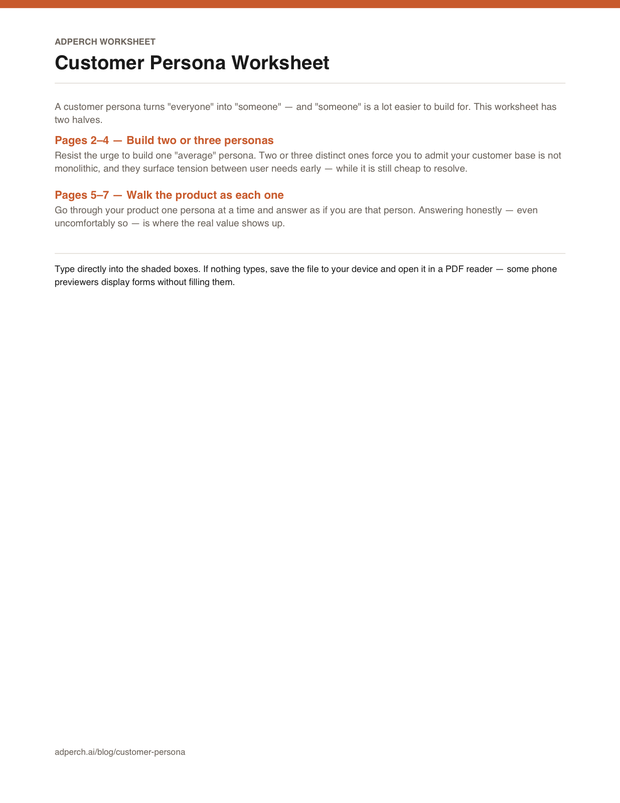
Resist the urge to build a single, "average" persona that tries to represent everyone. Instead, start with two or three distinct personas. This forces you to acknowledge that your customer base isn't monolithic, and it will surface tension between different user needs early — while it's still cheap to resolve.
Walk Through Your Product as Each Persona
This is the part that actually impacts how you build. Make sure to write down and keep a log of your answers. Once your personas exist, go through your product one persona at a time and answer these questions as if you are that person:
- What questions do I have as I use this?
- Is anything confusing or unclear?
- What's the smallest version of this I'd actually be willing to pay for?
- What features would be "nice to have," but aren't essential?
- What would I be willing to pay more for?
- What would make me quit using this altogether?
- How long would I realistically keep using this?
- How likely am I to tell other people about it?
Answering honestly — even uncomfortably so — is where the real value shows up. This exercise routinely exposes assumptions founders didn't know they were making. If your persona finds the product confusing, put effort into fixing it. If your persona really likes your product but doesn’t go anywhere they can share it, how can you address this gap in marketing? The questions you’re answering as your persona are also likely questions an investor will want to know. They can be a great free guide toward the viability, scalability, and potential traction of your product.
A Real-World Example: AdPerch (That’s Us!)
Here's how this looks in practice, using an example from AdPerch, a startup platform:
Where does our customer live? All over — but they need internet access and a computer. They also need a personal email address to create an account, and they need to be able to see the screen (or have someone who can navigate the site for them).
What does our customer do for a living? There's no single job title, but they're typically entrepreneurs in the early stages of their startup — usually just them and one or two co-founders. They work (or have worked) in a technical field and have the skills to build something from the ground up.
What are their hobbies? They’re creative and hobbies that foster curiosity. They have a desire and passion for learning outside of traditional settings.
What does their family situation look like? Busy and chaotic. Running a start-up has huge demands on time, energy, and mental reserves. They don’t have time for things that are complicated and don’t work well. The products they want will increase their productivity without increasing their time away from family.
Are they comfortable using technology? Not necessarily. Good ideas don’t always come from people with strong technology skills or knowledge. However, since our product is solely online and requires the ability to navigate websites effectively, our initial user will need to be comfortable using technology. They’ll need to understand technical terms, or be capable of researching and learning quickly. They need access to reliable internet and a personal email address.
Where are they most likely to see your product? They’re mostly likely to find us through social media posts and advertising, as well as finding our website through our blog posts (like this one!).
How much are they already spending on a similar product? The product price varies depending on what is offered. We’ve developed our product to include features that typically require paying for multiple products for the same suite of features. This allows us to show investors that people are actively paying for similar products, while highlighting why we win.
Where do we go from here? Working through our customer persona flagged a few issues and features that we’ll want to address as part of our roadmap. Our mission is expanding access to being inclusive. This includes creating a site and features that are accessible for people with low and no vision. We’re also working towards meeting the needs of users without strong technical backgrounds. Because we went through the process of creating customer personas, we’ve found where we need to pivot, and what we can add to our roadmap that will set us apart from any comparable companies. We’re creating a moat that elevates us as the company people will choose.
Turning Insight Into Action
A customer persona isn't a one-and-done branding exercise you file away and forget. It's a working document. Revisit it as you learn more about your actual users, update it as your product evolves, and use it every time you're debating a new feature, a pricing change, or a marketing channel.
If you're not sure where to start, use the worksheet below. Fill it out for two or three personas, then walk through your product (or your idea) as each one. You'll likely find at least one thing worth changing before you write another line of code — or spend another dollar on ads.
Download the worksheet (PDF, fillable — save it to your device to type in it)
The worksheet
Seven pages: build two or three personas, then walk your product as each one. The eight questions in it are the same eight above.
Typing in this preview won’t save. To fill it in and keep it, download it first.
Download the worksheet (PDF, fillable — save it to your device to type in it)
Ready to put your customer research in front of investors? Join the AdPerch community.