How to Build a Startup Moat: A Founder's Guide to Lasting Competitive Advantage (With a Free Worksheet)
Disclaimer: This content is provided for informational purposes only and does not constitute legal, financial, or investment advice. It does not guarantee funding, investment, or any particular business result. Consult a licensed attorney or financial advisor for guidance specific to your situation.
If you've spent any time around venture capital or startup strategy, you've probably heard the word "moat" thrown around. It's not just a feature of medieval castles anymore — it's one of the most important concepts a founder needs to understand. A startup moat is anything that protects your business from competitors trying to copy your idea and steal your customers. And in a world where AI has made it easier than ever to turn an idea into a working product, building a real moat isn't optional - it's survival.
In this guide, we'll break down exactly what a startup moat is, why it matters more than ever in the age of AI, and the practical strategies founders can use to build one — from execution speed to team dynamics to marketing positioning.
What Is a Startup Moat, and Why Does It Matter?
A moat, in business terms, is a sustainable competitive advantage that keeps rivals from encroaching on your market. Just like a moat protects a castle from invaders, a business moat protects your company from someone with a similar idea pulling your customers away.
Historically, building a defensible product took time, capital, and technical expertise — all of which created natural barriers to entry. Today, AI tools have collapsed that timeline. A competitor can go from concept to functioning prototype in a fraction of the time it used to take. That means founders can no longer rely on "we built it first" as a long-term strategy. You need a deliberate, multi-layered approach to defensibility. Here's how to build one.
1. Build Faster Than Anyone Else
Speed is one of the most underrated moats in startup strategy. But the goal isn't just to launch — it's to become the company that everyone else is chasing. When you're setting the pace, competitors are forced to react to you instead of the other way around, which puts you in a permanent position of advantage. While this strategy no longer holds the same defensive position as it did, it’s still essential.
The key to moving fast is having specific, actionable, achievable milestones. Vague goals like "grow the user base" or "improve the product" don't give you a clear path forward. Have you ever asked a child what they want to do when they grow up? And after they tell you, you say something about “you need to work really hard.” And then the conversation probably shifts or ends. But what does “work really hard” actually mean? If this is a child that is serious about their dream job and really wants to make it happen, how specifically can they make that happen? Recently our child told us they want to be an astronaut and go to space. The idea of my child being rocketed to space was terrifying, but it was something they were interested in. What I didn’t do - tell them they need to “work really hard.” Instead, we embarked on finding out what it would actually take. We researched and listed out the specific, actionable, achievable milestones that would take them from today to going to space.
Startups work the same way. The more precisely you define your milestones — fundraising targets, product launch dates, customer acquisition numbers — the less time you spend figuring out what to do next and the more time you spend actually executing. That efficiency compounds, and it becomes a moat in itself.
This kind of clarity also speaks directly to scalability, which is often where the real return on investment lives. Most startups aren't valued purely on what they've built today — they're valued on how far that product can grow and how large a market it can eventually serve. The more people who can use your product, the bigger the opportunity, and the more defensible your position becomes as you scale ahead of competitors.
2. Build a Healthy Co-Founder Relationship
It might not sound like a traditional "moat," but the strength of your founding team is one of the most consistent predictors of startup success — and one of the first things investors evaluate. A founding team that doesn't work well together is one of the leading causes of startup failure.
Startup life is a marathon that can take seven to ten years before you reach a real inflection point. That's a long time to be in a close working relationship with someone. Without a strong foundation, cracks will eventually show, and those cracks can sink an otherwise promising company.
So how do you build that foundation?
- Match on values and ideals, not just an idea
- Communicate constantly and honestly. Don't let small frustrations build into resentment.
- Be genuinely supportive of your co-founder, not just professionally aligned with them.
- Seek outside help if you need it. Founder therapy or coaching is increasingly common, and there's no shame in using it.
- Have a clear plan for handling disagreements. How you resolve conflict matters just as much — arguably more — than how well you get along day to day. Disagreements are inevitable; what separates strong teams from failed ones is having a process for working through them.
At AdPerch, we decided to take on the daunting task of starting a business with your spouse. That puts us within the roughly 10% of U.S. businesses with employees that are owned and operated by married couples. That gives us the advantage of already having met, gotten to know each other, supported each other, and trusted each other. We’ve built resilience alongside each other as we’ve endured some of life’s most challenging obstacles.
3. Stay Curious
It's tempting to get defensive when someone questions your product, especially after you've poured months or years into building it. But the founders who build the strongest companies are the ones who stay curious instead of protective. This is something at AdPerch we’ve had to put effort into fostering. Despite being generally very curious people, it can be hard to stay that way when receiving feedback.
Every conversation about your product is an opportunity to learn something that makes it better. When someone gives you critical feedback, resist the urge to explain why they're wrong. Instead, ask yourself: what can I take from this? You're not building your product just for yourself — you're building it for the people who will actually use it, and their input is a direct line to product-market fit.
This mindset shift — from defensive to curious — is a moat in disguise. It means your product keeps improving faster than a team that's too attached to their original vision to hear feedback. This is where having a well defined minimum viable product (MVP) and beta testing strategy are key.
4. Build a Solid Marketing and Positioning Plan
Even the best product in the world won't succeed if no one knows about it or believes in it. Marketing and traction need to be built in parallel with the product itself, not bolted on afterward.
Start by keeping potential customers engaged and excited before you even launch. Ask yourself:
- Is this something a customer would pay you to build specifically for them?
- Does the value only become obvious with a real-world use case?
- Can you find an early customer willing to serve as a case study or reference?
From there, focus on differentiation. Know exactly what you're bringing to the table that your competitors aren't. Study what your target customers are already saying about competing products — but instead of highlighting what competitors are doing wrong, focus your messaging on how you solve the problem better. Position your company around "we solve X, Y, and Z" rather than "our competitors fail at X, Y, and Z."
This approach does two things. First, it shows investors and customers that you're solution-oriented, which builds trust. Second, it protects your brand reputation — nobody wants to work with a company that's known for tearing down competitors instead of building something better.
Focusing on specific, well-understood problems (instead of chasing a vague, undefined one) also accelerates your path to an MVP. That speed lets you gather real feedback and hit your milestones before competitors even have a working prototype.
5. Understand the Barriers to Entry
With AI lowering the technical barrier to building a product, the real barriers to entry are shifting toward things that are harder to replicate: brand trust, customer relationships, proprietary data, and execution speed. Understanding exactly what makes your business hard to copy — and doubling down on it — is central to any moat strategy.
6. Consider Being a Values Forward Company
Consumers aren’t just looking for the best product anymore. They're looking for companies that align with their personal values. Having a core value, or set of core values, that are front and center is a competitive advantage. This can be as simple as creating an authentic mission statement. It might be tempting to quickly write one out, but it’s worth the time and effort in drafting one that resonates with customers. They can often tell when you don’t believe what you say. How do you keep customers invested in your company and product? Live out your mission statement, and be upfront and honest if you need to pivot. Just like in your business roadmap, list out what metrics you are using to prove that you are living up to that mission statement. People will start to lose trust in you if you claim one thing but do another. And once trust is lost, it can be nearly impossible to get back.
Final Thoughts
Building a startup moat isn't about one single tactic — it's the compounding effect of moving fast, building a strong founding team, staying open to feedback, marketing with clarity, and understanding what truly makes you hard to copy. In an era where AI has made it easier than ever for competitors to replicate a good idea, founders who treat moat-building as a deliberate, ongoing strategy — not an afterthought — are the ones who end up building companies that last.
Download the worksheet (PDF, fillable — save it to your device to type in it)
The worksheet
Three pages: work through each of the six strategies above as a team, and finish with one sentence describing your moat today.
Typing in this preview won’t save. To fill it in and keep it, download it first.
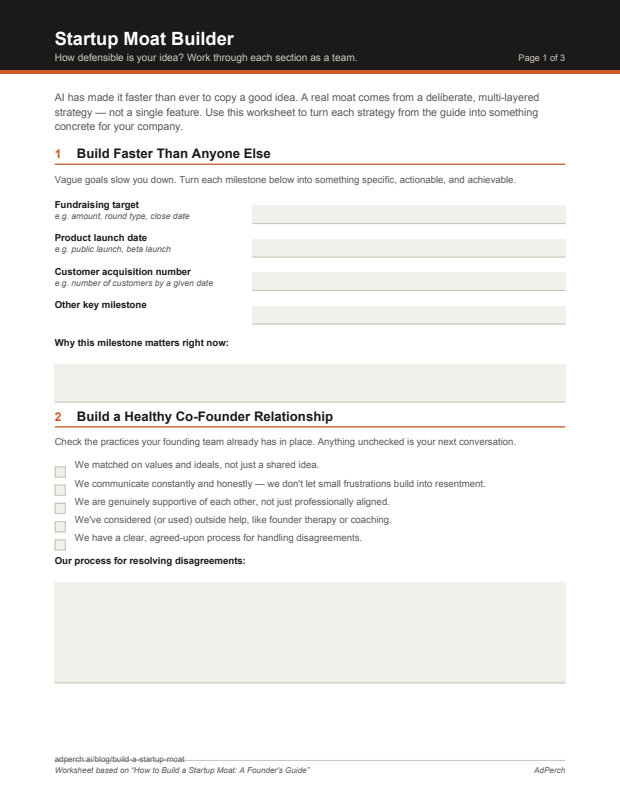
Download the worksheet (PDF, fillable — save it to your device to type in it)
Ready to highlight what sets you apart? Join the AdPerch community.